The model is simple: buy a finished platform once, host it on your own domain under your own brand, and charge clients a monthly fee to use it. Instead of selling your hours project by project, you sell access to software you already own. The code is the asset. Your clients pay rent on it, month after month, and you keep the relationship and the revenue.
We build client projects for a living, so we know both sides. One-off work resets to zero every time you deliver. White-label code is how a small team stops starting from zero each month, without spending six months building a SaaS from scratch.
Why one-off projects keep you broke
Every freelancer knows the cycle. You land a project, you work flat out for three or four weeks, you deliver, you invoice, you get paid. Then the calendar is empty again. The next project has to be found, pitched, quoted, and negotiated before another rupee or dollar comes in. Your income looks like a heartbeat monitor: a spike, then a flat line.
The problem is not the quality of your work. It is the shape of the deal. A one-off project sells a finished thing, and once it is finished, the money stops. If you take a holiday, get sick, or spend two weeks pitching instead of building, nothing comes in. You are not really running a business with revenue. You are running a job that you have to re-apply for every few weeks.
There is a second, quieter problem. Clients you built software for often drift away. The shop you made a billing system for, the salon you built a booking page for: they paid once, and now someone else sells them their monthly tools. The recurring money is real; it just goes to whoever owns the platform the client logs into daily.
The white-label model, step by step
White-label means the software carries your brand, not the brand of whoever built it. Your logo, your colours, your domain. Your clients may never know the platform started life somewhere else, and they do not need to. Here is how the model works in practice:
- Buy the licence once. You pay a one-time fee for a finished, tested platform instead of funding months of development yourself.
- Install it on your own domain. The platform runs on your server, under your name. You control the hosting, the data, and the client accounts.
- Set your own plans and prices. You decide what a monthly subscription costs, what each tier includes, and when to raise prices.
- Onboard clients one by one. Each client gets their own account on your platform. Onboarding the tenth client costs you almost nothing compared to the first.
- Collect monthly, support lightly. The software does the daily work. Your job becomes support, small tweaks, and finding the next client.
Notice what is missing from that list: building the product. The expensive, risky part, the months of development and testing, is already done. You are buying time as much as code. What you add is distribution: your clients, your reputation, your knowledge of one niche.
A worked example with real numbers
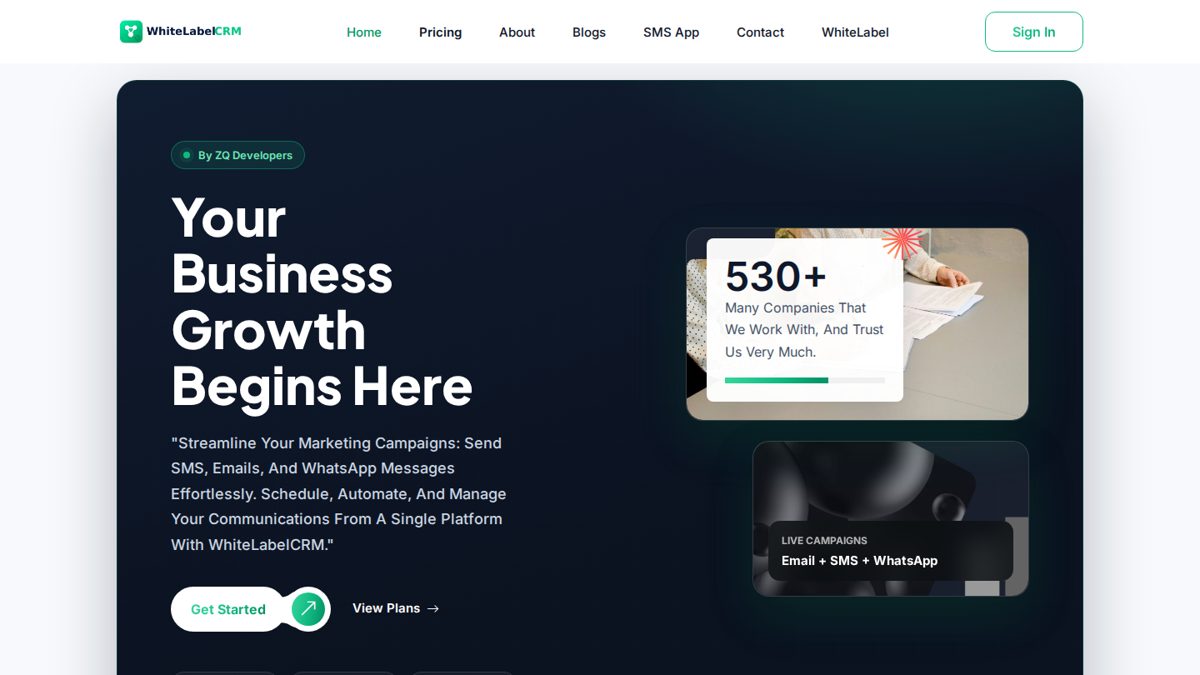
Let us run the maths on a real product so this stays concrete. On our catalogue, the WhiteLabelCRM source code costs $999 one-time, down from a regular price of $1,500. That is the full, unencrypted source code for a WhatsApp, SMS, email, and social media marketing platform, licensed for one production domain, with free installation within 24 hours and lifetime updates.
Now the example. Say you onboard 10 small businesses, salons, clinics, local retailers, and charge each of them, for example, $30 a month to run their WhatsApp and SMS campaigns on your platform. That is a deliberately modest price.
Ten clients at $30 a month is $300 a month. Against the $999 licence, the code pays for itself in a little over three months. Everything after that is gross revenue against your hosting and support time, and client number eleven onwards adds revenue without adding licence cost. This is an example calculation, not a promise: your prices, your niche, and how fast you onboard will move the numbers. But the shape holds at almost any price point, because the licence cost is fixed and the subscriptions repeat.
| Month | One-off project income (example) | White-label income: 10 clients at $30/month (example) |
|---|---|---|
| Month 1 | $999 project fee, then $0 | $300 (minus the one-time $999 licence) |
| Months 2-3 | $0 until the next project is sold | $600 |
| Months 4-6 | Depends entirely on new sales | $900 |
| Months 7-12 | Depends entirely on new sales | $1,800 |
| 12-month total | $999 per project, if you keep selling | $3,600 in subscriptions, licence already recovered around month 4 |
One-off work can beat these numbers in a good month; a big project pays more than $300. The difference is the bad months. Subscriptions arrive then too, and they stack: clients onboarded this year are still paying next year, while last year's projects pay nothing.
Source code vs fully managed: which fits whom
Not every white-label deal gives you the code, and the difference matters. With a source-code product like WhiteLabelCRM, you receive the full unencrypted code. You host it yourself, you can modify it, and the platform is genuinely yours to run. The trade-off is responsibility: your server, your updates to apply, your backups.
Contrast that with our WaAICalls white label offer. It costs $1,500 one-time plus $10 a month for the VPS, and it is a fully managed setup: we install and run the WhatsApp AI calling platform under your brand, and you sell it to your clients. There is no source code with this one, and we say that plainly because it changes who should buy it.
If you are a developer who wants an asset you control, can customise, and could extend with your own features, source code fits you. If you would rather never touch a server and just want a branded service to sell this month, fully managed fits you. Neither is better in the abstract. The mistake is buying one while expecting the other: managed access when you wanted to modify the code, or raw code when you have nobody to maintain it.
What to check in the licence before you build on it
A white-label business is built on someone else's code, so the licence is not fine print. It is the foundation. Before you pay anything, for any product from anyone, read the terms and check these points. Our own licence terms are public so buyers can do exactly that.
- SaaS and resale rights. Does the licence let you charge end users for access? A standard licence often covers one end product; running a subscription service usually needs the extended tier. On our products, the Extended licence is the one that covers SaaS use.
- Domain limits. WhiteLabelCRM is licensed for one production domain. That is fine for one branded platform, but know the number before you plan three brands on one purchase.
- Branding rights. Can you remove the original branding completely? Your customers should see your name everywhere, not the vendor's.
- Redistribution lines. Almost every licence, ours included, forbids reselling or sharing the source code itself. You are buying the right to run a business on it, not to sell copies of it.
- Updates and support. Lifetime updates and a human you can reach are worth more than a slightly lower price from a seller who disappears.
If a seller cannot answer these questions clearly before you pay, that is your answer. Walk away and buy from someone who publishes their terms.
Your first 5 clients: a practical plan
You do not need ads or a launch. Your first five clients are almost certainly people who already know your work. Start there.
First, list every past client whose business talks to customers regularly: retailers, clinics, academies, restaurants, real estate agents. You built for them once, so their trust is already earned. Second, pick one niche for your platform rather than selling to everyone. A marketing platform pitched only to clinics, with two or three message templates written for clinics, sells better than a generic tool.
Third, put the demo on your own domain with your own branding and show it live. A working login beats a slide deck every time; let the client tap around in it on their phone. Fourth, make the first offer small and easy: a modest monthly price, setup done for them, and the first campaigns written by you. You are not selling software at this stage. You are selling the outcome, more bookings, faster replies, fewer missed customers, and the software is how it arrives.
Fifth, once two or three clients are paying, ask each one for one introduction. In local business communities, one happy clinic owner is worth more than a month of cold outreach. Five paying clients will not make you rich. They will cover the licence, prove the model with your own numbers instead of our examples, and give you the confidence to raise prices for client six onwards.
Where to start
If the source-code route fits you, start with WhiteLabelCRM: $999 one-time, your brand everywhere, built-in subscription plans and billing so you can charge your customers monthly and keep 100 percent of the revenue. If you want a branded service without running servers, look at WaAICalls white label instead. Browse the rest of the full catalogue if a different niche fits your client list better, and read the licence terms before you decide. The first subscription you sell changes how your next year looks.